
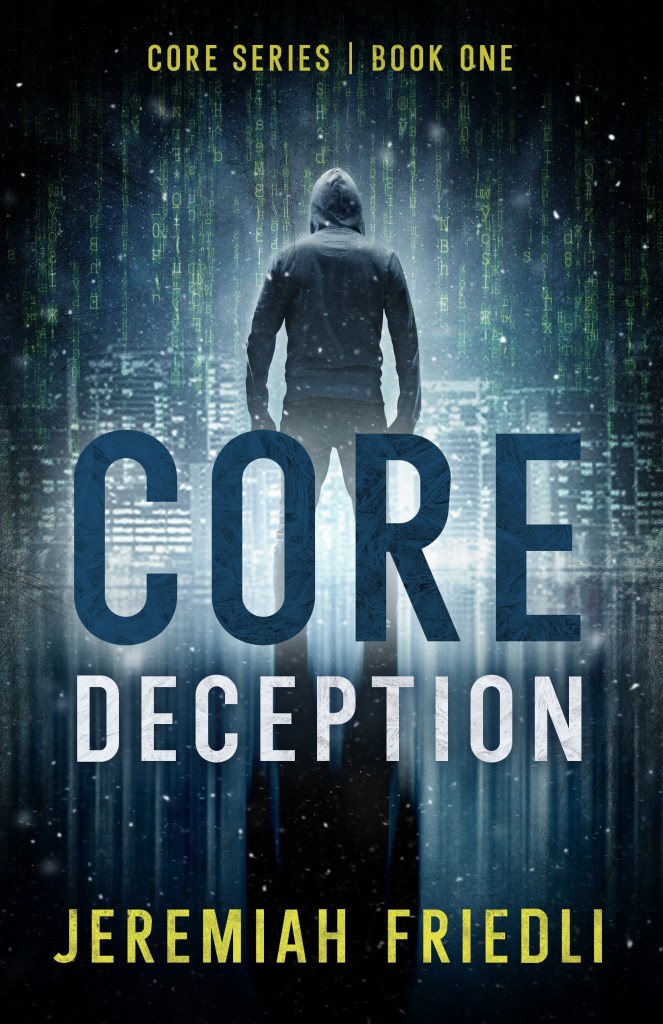
Hello readers! Help me welcome author Jeremiah Friedli for an interview. Today, February 26, marks the release of his full-length novel CORE Deception! Read on to learn about Jeremiah’s writing (and download your free prequel novella!).
LB: How do you weave Christian themes into your writing, and why is this especially important for teens and other young readers?
JF: I’ve tried hard to learn from those who do this well (e.g., Tim Shoemaker, Kendrick Brothers). Simply put, I create stories where some of the characters are Christians experiencing situations that challenge their faith or force them to grow in their faith. As a Christian, when I read about other Christians dealing with challenges, fictional or real, it gets me thinking. Like, how well would I handle a situation like that? How good is my relationship with God in that area?
In CORE Deception, Seth doesn’t see himself as a fearful person. But as he faces the challenges of finding the incognito devices, big fears arise and influence his decisions. Through scripture and the wise guidance of his dad, Seth finally sees how fear is dictating his actions. But his fears don’t instantly vanish, nor does he instantly start making only good choices. He knows what the right response is, but knowing isn’t the same as living it out. As he continues his journey, he works on trusting God versus his fears, sometimes succeeding and sometimes not.
People tend to change slowly, or if we change quickly, it’s only when drastic situations push us to rethink ourselves. And as Christians, sometimes God allows drastic situations to come so to refine us and draw us closer to Him. If you look at some of the stories of Christianity’s giants (like the Apostle Paul, Martin Luther, George Washington, Brother Andrew), you’ll see this dynamic at play.
Every believer needs encouragement to grow in their relationship to God, whether you’re 18 or 80 years old. Stories are a powerful tool to do that.
LB: Yes, and this is a great explanation. Sci-fi captivates readers as our minds take in imaginative ideas and ponder the possibilities. Tell us about your heart for writing sci-fi stories. Do you think you’d ever write something in a different genre?
JF: Definitely. I love many sci-fi stories and have really enjoyed creating a sci-fi storyworld for my CORE Series. I love technology and the ability to dream in that arena. And among other things, I love creating new places, societies, and economies.
But I like to think of myself as writing young adult stories with suspense and intrigue. Or as I sometimes say, Christian YA thrillers. Right now, that happens to be sci-fi dystopian. But that doesn’t mean you won’t eventually see some post-apocalyptic, medieval fantasy, kingdom adventure, mystery, or modern royalty. I have a lot of ideas, and I can’t seem to write them fast enough. But whatever the genre, readers can expect fast-paced stories with teen characters.
LB: Sounds like readers will have plenty to look forward to! What inspired the CORE Series?
JF: The idea was largely birthed during 2020 when I faced fears I didn’t know I had. It was an odd, disruptive time for many, and somehow the unknowns of a strange illness and the changes that came to just about every aspect of life triggered fear in me. I’ve struggled with fear of acceptance, fear of failure, and fear of incompetence before—to name a few fears. But this was new to me. It was fear that dominated my thinking and tried to control my actions. (And really, doesn’t all fear do that?)
Something told me this wasn’t right—more like Someone. As a Christian, I shouldn’t fear like that, not if I believe the Bible. After all, our future is secure, no matter what happens to us physically. And as Christ-followers, we have more hope than anyone else.
So why was this fear so strong? It was a while later that I came across a quote by Max Lucado. He put it really well: “Fear, at its center, is a perceived loss of control.” (https://maxlucado.com/fearless/)
Ouch, that was me. He nailed it. It felt like I had lost control of almost every aspect of normal life. Not that I had control in the first place. And that was the foundational deception of my fear. Life had been going fairly well and not too far from what I wanted. I’d built my stability around that instead of the hope I have in Jesus. Experiencing this fear was painful because it forced me to face a reality—I wasn’t trusting God like I thought I was, like I wanted to think I was. But as painful as that was, it was a gift.
That’s the struggle for Seth in my book CORE Deception. But that’s not all. I had this creative idea simmering on the back burner of my mind that included espionage, hacking, a dystopian government, and somewhere really cold. Soon the pieces started coming together and forming a story. A dystopian government was a perfect fit for the themes God laid on my heart, as well as a great landscape to adapt elements of Cold War spy tradecraft like codes, ciphers, and dead drops.
LB: That’s a rich backstory to the story! Can you tell readers a little about why you chose an ice age and Hawaii as your setting?
JF: For the last few years, I’ve been intrigued with the idea of an arctic-like setting. Such extreme cold is vastly different from my home on the high plains of West Texas, and yet I get a little hint of it during winter. (Negative windchills, anyone?  ) When the initial ideas of CORE Deception leaned dystopian, I got my chance to use that arctic-like setting idea.
Tyrannical governments like control—you don’t have to dig very much history to see what I mean—and extreme cold is one way to hold everyone within a city. If they provide the populace with barely enough cold weather gear to walk from building to building, there are no problems with street protests or uprisings, right? That’s why it worked well in CORE Deception when the main character Seth and his sidekick Krystin found a way around [redacted]. Oops, I better not spoil that part of the story. You’ll have to read it to discover their workaround for the prohibitive temperatures.
So that explains the extreme cold, but how did we get to Hawaii?
In CORE Deception‘s early stages, Iceland was the closest real place to what I imagined. It captured some of the vibe I was looking for, so I let it serve as a placeholder until I knew more. I even played around with Scandinavian names for everyone, but eventually that had to go…except for Krystin’s family. The story called for the setting to be part of America, inhabited by Americans. How could I do that? There’s Alaska, a setting I love, but quite a few fiction stories had already used Alaska.
While brainstorming with an editor, she suggested Hawaii. It’s American, has volcanic activity, and an ice age could make it arctic-like. Problem solved!

LB: That’s very interesting. What is a lasting impact you hope your books have on your readers?
JF: Sprinkled in with CORE Deception‘s intrigue, cyber chess-play, and action is the theme of fear—and what God says about it. One of my favorite Jesus quotes is the last part of Mark 5:36, “Do not be afraid, only believe.” I also created a “mini devotional” on fear, which has 40 short insights on what the Bible has to say about the topic.
LB: “Do not be afraid, only believe” is a meaningful takeaway 🙂 As a homeschooling mom, I’m very encouraged when I see homeschoolers and homeschool graduates doing wonderful things. What role did homeschooling play in your creative writing?
JF: I ended up enjoying the creative writing assignments and took them further than necessary. My parents fostered this creativity, and not just for school academics. I was allowed and encouraged to explore the world of creative storytelling.
When I think back on the kinds of activities they guided their six children toward, I believe they wanted us to actively use our minds to think, imagine, problem-solve, etc. (Side note: Einstein is famously known for stressing the importance of imagination.) Even the toys they encouraged us to play with—they were building blocks of creative play, sometimes literally! My siblings and I spent countless hours having fun with—not the fully equipped soldier or fully constructed and furnished dollhouse (for my sisters…though sometimes the dollhouse was converted into a castle)—but with figures we could accessorize (cowboys, knights, etc.) and building materials (blocks, boards, train track). We had videos and gaming, but they were careful to keep that in balance.
While some may say I have a creative bent, I give my parents a lot of credit for curating whatever creativity was there.
Having siblings who wrote helped a lot. Sometimes there’d be a writing craze, perhaps sparked by one siblings’ story assignment that gained interest from others. The camaraderie and friendly competition was a blessing.
Some of my favorite memories are of cowriting with my brothers and sisters. For example, one day my sister and I decided we’d write a sci-fi story together. One of us would write for a few minutes, then once the time expired, they had to get up and the next person would write for the same allotment of time. Otherwise, there were pretty much no guidelines. The story started off kind of goofy and then just got corny. There were times when I visualized the plot going one direction, only to have my sister take it in an entirely different direction (I’m sure I did the same to her  ). It was so spontaneous, quite random, and just loads of fun. We finally put our heads together for the conclusion and then shared it with the rest of the family. It’s just a silly short story, but we still talk and laugh about it years later.
LB: I think every parent wants their children to get along as well as you and your siblings do! What are you working on next?
JF: I’m well into the planning phase of CORE Deception’s sequel. Readers can assume more suspense and espionage while exploring new facets of the CORE Series storyworld and digging deeper into characters like Seth, Krystin, and Jhalak. The book’s title and plot are a secret right now, but here’s a little teaser:
A relentless pursuer.
An unpredictable ally.
The opportunity of a lifetime.
Can seventeen-year-old hacker Seth Alvarez survive a daring undercover mission that could change the course of a nation?
I have at least one more novel in the CORE Series, and I’m praying about what should be written after that. Several ideas are pushing their way to the front of the line, and I’m not sure which one will be next. It could be another sci-fi, a modern thriller, kingdom adventure—you get the idea.
LB: I’m glad to hear you already have a sequel well underway! Thank you, Jeremiah, for being on my blog today! Readers, be sure to download your FREE copy of Jeremiah’s prequel novella, and check out CORE Deception!
JF: Thanks so much!
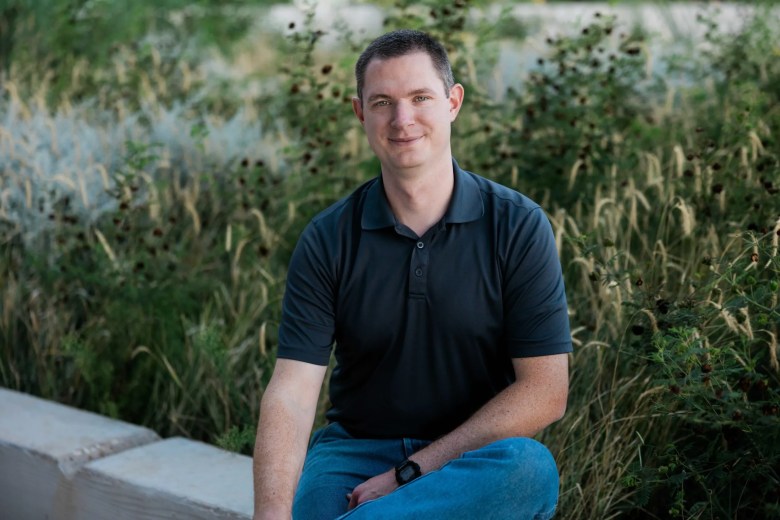
Jeremiah Friedli is a homeschool graduate, lifelong writer, ice cream lover, and native Texan who can imagine danger just about anywhere and anytime. He enjoys getting out in God’s creation, whether that’s hiking, camping, running, or just reading quietly on the porch. His favorite books—the kind he loves to write—are those annoyingly good page-turners that keep him up long after he really should have gone to bed. When he’s not browsing grocery stores for the latest deals on Blue Bell ice cream and frozen pizza, you might find him seated behind a large screen with one of his beloved spreadsheets or watching a movie with his family. Learn more and connect with him at jeremiahfriedli.com.
Check out CORE Deception on:
 M Liz Boyle